2026 SLS Book Recommendations
The following books were recommended by our 2026 speakers as preparatory materials for this year's series. They are not required reading, but attendees may find them useful tools to enhance their understanding of this year's topics and theme.
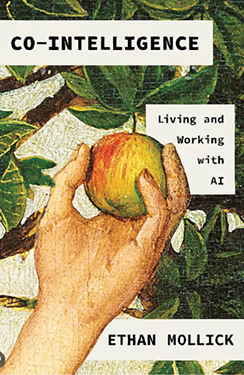 Co-Intelligence: Living and Working With AI
by Ethan Mollick
In the whirlwind of tech hype, Wharton professor Ethan Mollick offers a refreshing and indispensable perspective: AI is not a tool to be mastered, but a co-pilot to be embraced. In Co-Intelligence, Mollick argues that we have entered an era where “working with a machine” has evolved into “collaborating with an intelligence.”
For the lifelong learners of the Osher community, this book is an invitation to move from observation to participation. Mollick bypasses the dense jargon to focus on the practical and philosophical shift required to thrive in an automated world. He explores how AI can augment our creativity, sharpen our decision-making, and even provide companionship, all while maintaining a clear-eyed view of the risks to our social fabric.
As we prepare for our summer series, Co-Intelligence serves as an essential field guide. It challenges us to rethink what makes us uniquely human in the face of capable machines and prepares us to engage deeply with the speakers who will be dissecting these very shifts.
This book is recommended by speaker Brinnae Bent, whose July 8 session is titled “What Can the Declaration of Independence Teach Us About Artificial Intelligence?” AND by speaker Patrick Wheeler, whose July 29 session is titled "What Will Be the Economic Impacts of AI?"
Book Info: "Co-Intelligence: Living and Working With AI" by Ethan Mollick (Portfolio; ISBN 9780593716717)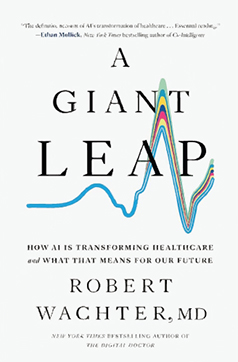 A Giant Leap: How AI is Transforming Healthcare
by Robert Wachter, M.D.
Just released in February, A Giant Leap is a timely addition to our Summer Lecture Series. Dr. Robert Wachter, Chair of the Department of Medicine at UCSF and the “father of the hospitalist field,” provides a clear-eyed roadmap for the most personal frontier of technology: our health.
Wachter argues that while the American healthcare system has historically resisted digital disruption, the “giant leap” of generative AI is finally piercing that shield. Drawing on over 100 interviews with pioneers and frontline clinicians, he explores a world where AI doesn’t just manage paperwork, but matches—and occasionally exceeds—human doctors in diagnosis and even empathy.
This book is an essential guide to the future of patient care. Wachter avoids blind optimism, candidly addressing the risks of “hallucinations” and algorithmic bias. His central thesis? That AI doesn’t have to be perfect; it just has to be better than our current, often-burdened system. It is a profound look at what it means to heal, and be healed, in an age of astonishing technology.
This book is recommended by speaker Dr. Adam Rodman, whose July 15 session is titled “Can AI Think Like a Doctor?”
Book Info: "A Giant Leap: How AI is Transforming Healthcare" by Robert Wachter, M.D. (Portfolio; ISBN 9798217044245)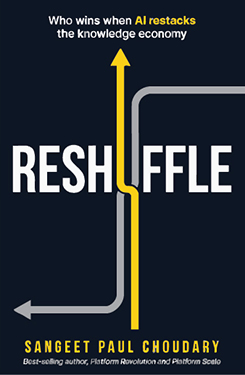 Reshuffle: Who Wins When AI Restacks the Knowledge Economy
by Sangeet Paul Choudary
Sangeet Paul Choudary argues that AI's true impact isn't just task automation, but its ability to fundamentally reorganize entire systems (workflows, organizations, ecosystems) through "unbundling" and "rebundling" components. The book identifies four key tensions—workers vs. tools, tool providers vs. firms, consolidators vs. disrupted industries, and individuals vs. incumbents—to explain who wins and loses as AI restructures the knowledge economy, moving beyond a narrow focus on individual tasks to systemic transformation.
Patrick Wheeler says, "Sangeet...writes clearly about AI and business."
Visit the goodreads page about this book.
This book is recommended by speaker Patrick Wheeler, whose July 29 session is titled "What Will Be the Economic Impacts of AI?"
Book Info: "Reshuffle: Who Wins When AI Restacks the Knowledge Economy" by Sangeet Paul Choudary (independently published; ISBN 9798294127213)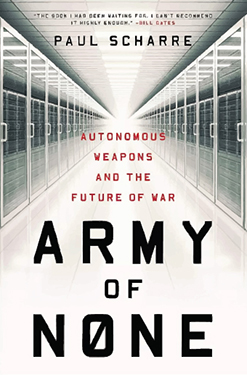 Army of None: Autonomous Weapons and the Future of War
by Paul Scharre
In Army of None, Paul Scharre—a former Ranger and Pentagon policy expert—grapples with one of the most chilling frontiers of the digital age: the rise of weapon systems that can choose and eliminate targets without human intervention. For the Osher community, this isn't just a tech briefing; it is a profound exploration of how AI is redefining the ethical and strategic boundaries of American power.
Scharre masterfully navigates the "OODA loop" (Observe, Orient, Decide, Act), illustrating how AI accelerates combat to speeds beyond human cognition. He avoids alarmist tropes, instead offering a nuanced look at the trade-offs between military efficiency and the "human in the loop" necessity. As we prepare for our Summer Lecture Series, this book serves as an essential foundation. It forces us to ask: If a machine makes a mistake on the battlefield, who is held accountable?
Scharre’s insights are indispensable for anyone looking to understand the gravity of the AI revolution. Join us this summer to dive deeper into these transformations.
This book is recommended by speaker Michèle Flournoy, whose August 5 session is titled “Is AI Leading Us Toward a More Dangerous World Disorder?”
Book Info: "Army of None: Autonomous Weapons and the Future of War" by Paul Scharre (W.W. Norton & Co.; ISBN 9780393356588)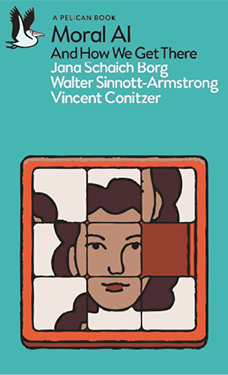 Moral AI: And How We Get There
by Walter Sinnott-Armstrong, Jana Schaich Borg, and Vincent Conitzer
As AI becomes an invisible hand in our healthcare, legal systems, and daily lives, we are left with a pressing question: Can a machine truly understand right from wrong? In Moral AI, Walter Sinnott-Armstrong and his colleagues move beyond the “Terminator” sci-fi tropes to address the urgent, real-world ethics of the algorithms already shaping America.
The authors—leading experts in philosophy, neuroscience, and computer science—argue that we shouldn’t just fear AI; we should teach it our values. This isn’t merely a technical manual; it is a profound exploration of how we can build “moral guardrails” into code. For an audience that has witnessed decades of societal transformation, this book offers a grounded, sophisticated look at how we can ensure technology reflects the best of human nature rather than our worst biases.
This book equips you with the vocabulary to engage with our upcoming Summer Lecture speakers and the insight to navigate a future where the line between human judgment and machine logic continues to blur.
Visit the goodreads page about this book.
This book is recommended by speaker Walter Sinnott-Armstrong, whose August 12 session is titled “How Can We Build Human Morality Into AI?”
Book Info: "Moral AI: And How We Get There" by Walter Sinnott-Armstrong, Jana Schaich Borg, and Vincent Conitzer (Pelican; ISBN 9780241454763)Last Updated